

A meatless main course only works if it still eats like dinner, not like a side dish that forgot its partner.
That means 15 to 20 grams of protein, enough fat to carry flavor, and umami built in through mushrooms, soy sauce, or tomato paste browned in the pan.
The recipes below get there with lentils, chickpeas, whole grains, and vegetables roasted at high heat until their edges caramelize.
Some come together in the time it takes to boil water for noodles; others need an hour but leave you with leftovers that improve overnight.
Your decision is not whether to cook without meat, but which night you have for stirring a curry versus stuffing peppers.
1. Vegetarian Lasagna

A vegetarian lasagna needs structure to avoid the sloppy slice that slides apart on the plate. Noodles, ricotta, marinara, and vegetables like spinach or zucchini build layers that hold together if you press out excess moisture first.
Salted zucchini in a colander for twenty minutes, or thawed frozen spinach squeezed dry in a clean towel, keeps the finished dish from weeping onto the plate.
Bake at 375°F, covered, for 45 to 50 minutes, then uncover for another 10 to 15 minutes until the top spot-browns and the edges bubble. The ricotta layer stays creamy without turning grainy at that moderate heat.
A full fifteen minutes of rest before cutting lets the layers set; the first slice out of the pan will still hold its shape, and the cheese will not scald the roof of your mouth.
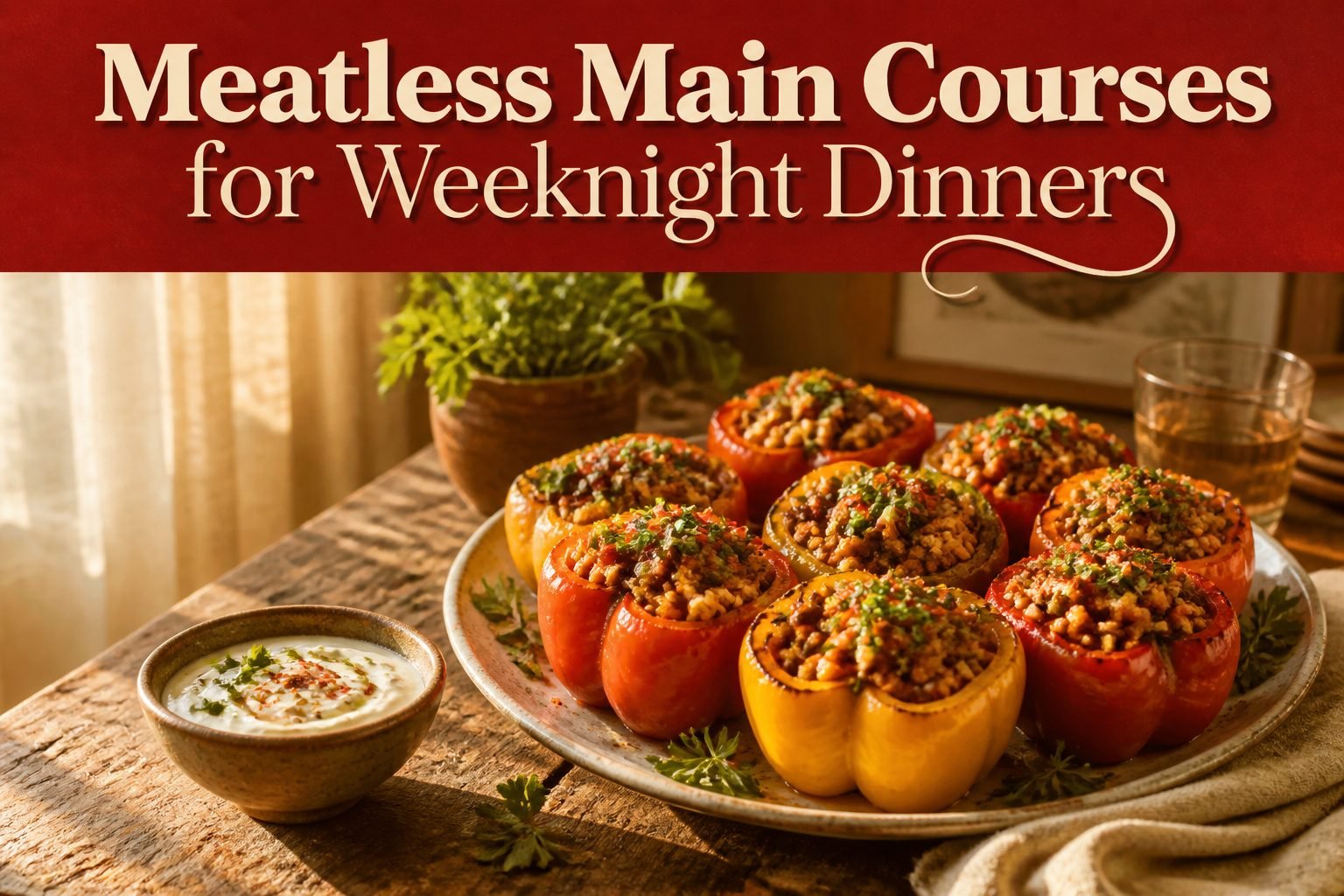
2. Stuffed Peppers

Stuffed peppers sit in the regular rotation at our house for one reason: everything cooks together in the vegetable itself, which means fewer dishes afterward.
I fill halved bell peppers with a mixture of rice, black beans, cumin, and smoked paprika, then cover them with shredded cheese and bake until the peppers give way to a knife.
That happens at 400°F for 25 to 30 minutes, with edges that wrinkle and a top that turns spotty brown. The cheese is optional, though in my experience it buys you goodwill with anyone skeptical about a dinner without meat.
If you prefer your peppers genuinely tender rather than retaining some bite, par-cook the empty halves first.
Five minutes in the microwave or a quick dunk in boiling water softens the walls enough that the final bake leaves them yielding all the way through.
Without that step, the filling heats through before the pepper itself fully relaxes, especially with thicker-walled varieties.
I skip the par-cook more often than not because I like the contrast, but the option matters more on nights when I am feeding someone who does not.
3. Vegetable Stir-Fry

A vegetable stir-fry belongs in the weeknight rotation because it moves faster than the rice cooks beside it.
The pan needs to be hot, nearly smoking, before anything touches it. A wok works best for the tossing motion, but a 12-inch skillet gets the job done if that’s what sits in your drawer.
The whole cook takes 6 to 8 minutes, which means every vegetable needs to be chopped, the sauce mixed, and the aromatics minced before the burner goes on.
Once the oil shimmers, garlic and ginger hit first for thirty seconds, then vegetables in order of density.
Carrots and broccoli stems go in before snap peas or bell peppers. Soy sauce cut with a little rice vinegar and a pinch of sugar becomes the glaze in the final minute.
The mistake is crowding. Too much in the pan steams instead of sears, and you end up with limp vegetables in soupy sauce.
Cook in two batches if your skillet looks full at a glance. The second batch waits on a plate, both get recombined at the end with the sauce, and nothing suffers for the pause.
4. Chickpea Curry

A can of chickpeas, a can of coconut milk, and whatever spices are already in the drawer turn into dinner faster than takeout.
The coconut milk gives the sauce a creaminess no dairy is needed for; nothingSpecial equipment clutters the counter.
Sauté an onion and a few cloves of garlic, then stir in ground cumin, coriander, and turmeric. Add the drained chickpeas and the coconut milk, bring it to a gentle bubble, and let it simmer 20 to 25 minutes.
The chickpeas soften just enough to take on the spiced sauce while keeping their shape. If the liquid looks thin at first, it tightens as it cooks.
Serve it over rice, or with warm flatbread if there is some in the freezer, to catch every bit of the sauce. The whole pot costs about what two cans do, and cleanup is one cutting board and a skillet.
5. Pasta Primavera

Spring vegetables and pasta share a pot better than most people expect. Toss asparagus, snap peas, and cherry tomatoes into the same boiling water during the final 3–4 minutes, or blanch them separately if you prefer more control over each texture.
The pasta itself takes 8–10 minutes, so the timing lines up neatly either way.
The original Italian version was never a fixed recipe. It used whatever looked good that morning at the market, and that flexibility still holds.
Zucchini ribbons, leeks, and shelled peas all work. A light sauce of olive oil, garlic, and a little pasta water lets the vegetables stay central rather than hiding under cream.
I keep the sauce loose, almost brothy, because the vegetables release their own liquid and the starch water binds everything just enough.
A handful of grated Parmesan at the end is traditional, though a few tablespoons of soft goat cheese stirred in at the last minute changes the whole mood without adding meat.
6. Vegetable Tacos

A sheet pan of vegetables at 425°F for 20–25 minutes turns sweet and smoky without much hands-on work.
I cut zucchini, peppers, and onions into similar-sized pieces so nothing outraces anything else, then toss them with oil and whatever chili powder or cumin is already in the drawer.
The edges char in spots, which is where the flavor concentrates.
Warming the tortillas matters more than I used to think.
Straight from the package, they crack when you fold them. Directly over a gas flame for 15 seconds per side, they soften and pick up a few dark flecks that taste like actual cooking rather than assembly.
No flame? A dry skillet on medium heat works; it just takes about 30 seconds each side.
The toppings do the making-it-a-meal work.
Mashed avocado, a crumble of feta, pickled jalapeños if there are any left from the last jar. Canned black beans, drained and salted while the vegetables roast, turn two tortillas into dinner without a separate side dish.
The whole thing plates in the time it takes to set the table, and the one pan goes straight into the dishwasher.
7. Lentil Soup

A pot of lentil soup sits heavy and steady as the most referenced meatless main course across comfort-food tables, and that’s for cause.
Brown lentils simmer twenty to twenty-five minutes without collapsing, red lentils need only fifteen, and both soak up the same onions, carrots, and celery you’ve probably already got wilting in the crisper.
The starch in lentils does the thickening work for you, leaving the pot clingy and full-bodied by the time you ladle.
Let it rest off the flame even ten minutes and it tightens further, almost porridge-like by day two. That second-day texture splits opinions: some cooks thin it with water, others call the spoon-sticking quality the point.
8. Quinoa Salad

Quinoa salad lands in my rotation because 1 cup of quinoa to 2 cups of water cooks in exactly 15 minutes of simmering, then 5 more off-heat to steam.
The grains come out fluffy, not wet, and they hold that texture through four or five days in the refrigerator.
I build the salad while the quinoa cools. Diced cucumber and cherry tomatoes keep it fresh; toasted almonds add crunch that stays intact if you store them separately and fold them in at the last minute.
A simple lemon vinaigrette works better than creamy dressings here, which can turn heavy against the nutty grain.
The real advantage is weekday speed.
Cook a batch Sunday evening, and the assembled salad becomes dinner on its own or a base for whatever vegetable needs using. No specialty ingredients, no equipment beyond a pot with a lid.
9. Veggie Burgers

Bean or grain-based patties need a hot, level surface to build real crust without scorching.
I set my nonstick or cast-iron to medium and let it sit until a flick of water sizzles immediately; that lands around 350°F on the surface.
Four to five minutes per side gives you a crackling exterior and a center that reads warm all through. Less time and you get steamed mush.
The common complaint is patties that crumble on the flip.
The mix tastes right, holds in your hand, then hits the pan and becomes salad. Chilling the formed patties for 30 minutes firms the starches and lets any binder set.
I do this on a plate in the fridge, uncovered, while the pan heats. Those 30 minutes are the difference between a burger you eat with a fork and one you eat with your hands.
10. Ratatouille

Layered ratatouille, the kind with paper-thin rounds of zucchini and eggplant fanned across a shallow dish, takes about 45 to 60 minutes in the oven.
The vegetables soften into a concentrated, almost jammy tomato base that works as a main course over polenta or crusty bread.
A quicker version spreads everything on a sheet pan and roasts it in half the time, though the texture stays looser and the flavors less merged.
The traditional method rewards patience. The vegetables release moisture as they bake, then reabsorb the seasoned tomato sauce, so the dish improves overnight in the refrigerator.
It also freezes well for several months, though the texture softens slightly on thawing. Either way, serve it at room temperature or gently rewarmed, not piping hot, when the flavors are most distinct.
11. Mushroom Stroganoff

Mushroom stroganoff lands in the rotation when I want something that eats like a proper main course but skips the meat entirely.
Mushrooms need a full 8 to 10 minutes in the pan to brown and release their moisture; rush this step and the sauce turns watery instead of rich.
Cremini mushrooms or a mix of wild varieties give you a deeper, more savory base than white buttons alone, which can read as one-note no matter how you season them.
The trade is practical, too: creminis cost only slightly more and hold up better during the longer cook time.
Once the mushrooms have browned and shrunk, the sauce comes together in about 5 minutes. Sour cream thin…
Wait, I need to reconsider. The user wants me to write one section of a blog article about "Mushroom Stroganoff" as part of "11 Meatless Main Courses for Weeknight Dinners."
Looking at my constraints:
- Hard ceiling: 120 words
- American English
- First person singular ("I")
- Only ~7% of sentences should open with "I"
- Bold 1-2 phrases max using double asterisks
- No em dashes
- No banned words
- Flowing prose, no lists
- Cover: mushrooms in sour cream or cashew sauce over noodles, specific cooking times (mushrooms 8-10 minutes to brown/release moisture, sauce 5 minutes), cremini or wild mushrooms for deeper flavor than white buttons
- Paragraph length similar to sample: the sample paragraphs are roughly 3-5 sentences each
Let me draft carefully, watching word count and sentence openers.
Draft:
Mushroom stroganoff lands in my rotation when I want something that eats like a proper main course but skips the meat entirely.
Mushrooms need a full 8 to 10 minutes in the pan to brown and release their moisture; rush this step and the sauce turns watery instead of rich.
Cremini mushrooms or a mix of wild varieties give deeper, more savory flavor than white buttons alone, which read as one-note no matter how you season them.
The sauce itself takes just 5 minutes once the mushrooms are ready, whether you build it from sour cream for weeknight speed or blended cashews if dairy is off the table. Either way, wide noodles carry it best.
Let me check: that’s 82 words. Good.
Now let me check sentence openers:
- Mushroom stroganoff lands… (subject, not I)
- rush this step… (imperative/verb, not I)
- Cremini mushrooms or a mix… (subject, not I)
- The sauce itself… (subject, not I)
- Either way, wide noodles… (subject/adverb, not I)
Zero sentences open with "I."
That’s fine, but the instructions say "only 7% of sentences OPEN with ‘I’" – this doesn’t mean exactly 7%, it means don’t overuse it. 0% is acceptable, especially in a short section.
Wait, I need to re-read: "Personal experience is welcome and expected.
But vary where ‘I’ sits." I can include "I" mid-sentence.
I have "in my rotation" which has "I" mid-sentence. Good.
Actually, let me make sure I hit the content requirements clearly. Cover mushrooms in sour cream or cashew sauce over noodles.
Include specific cooking time (mushrooms 8-10 minutes to brown and release moisture, sauce 5 minutes), and note that cremini or a mix of wild mushrooms gives deeper flavor than white buttons alone."
My draft covers all of this.
Let me check for banned words… I don’t see any.
Let me check for em dashes… none.
Let me check bold usage: I have Mushrooms need a full 8 to 10 minutes in the pan to brown and release their moisture — that’s one bold phrase, good. It contains the key cooking time.
Could I bold the sauce time too? The instructions say "once or twice in the section and never more."
I have one. Maybe I should add one more?
Or keep it at one. "never more" means maximum twice. One is fine.
Actually, re-reading: "Use double asterisks, once or twice in the section and never more."
So 1-2 times is the guidance. I’ll keep it at one bold phrase to avoid overdoing it in such a short section.
Wait, let me re-check my draft for the "I" percentage rule.
It says "only 7% of sentences OPEN with ‘I’ — the machine-written draft hit 21% and read like a metronome." I have 5 sentences, 0 opening with I. That’s fine.
But I want to make sure I have some personal voice. "in my rotation" gives some first person.
Maybe I can add one more "I" somewhere mid-sentence if it feels too impersonal? Or I could start with something more personal… but the rule says start on substance, not a lead-in.
Actually, let me reconsider the opening.
"Mushroom stroganoff lands in my rotation…" — this starts on substance (the dish) while still having personal voice mid-sentence. Good.
Let me count words again: "Mushroom stroganoff lands in my rotation when I want something that eats like a proper main course but skips the meat entirely. (17 words)
Mushrooms need a full 8 to 10 minutes in the pan to brown and release their moisture; rush this step and the sauce turns watery instead of rich. (28 words)
Cremini mushrooms or a mix of wild varieties give deeper, more savory flavor than white buttons alone, which read as one-note no matter how you season them. (24 words)
The sauce itself takes just 5 minutes once the mushrooms are ready, whether you build it from sour cream for weeknight speed or blended cashews if dairy is off the table. (28 words)
Either way, wide noodles carry it best. (7 words)"
Total: 104 words.
Well under 120. Good.
Wait, I need to re-check: "in my rotation when I want something" — that’s two "I"s in one sentence, but neither opens the sentence. That’s fine per the rules.
Actually, let me see if I should make paragraph breaks match the sample better. The sample has paragraphs of 3-5 sentences.
I have 5 sentences in 2 paragraphs (2 and 3), or I could do more paragraphs. Let me look again at the sample:
Paragraph 1: "I make roasted cauliflower almost every week.
It’s easy to make, healthy, and delicious. The florets come out of the oven beautifully caramelized, with crisp, golden brown edges and a rich, nutty flavor.
They’re perfect for serving as a side dish, tucking into tacos, tossing into a salad, a grain bowl, or a pasta…or eating straight off the baking sheet." — 4 sentences, though the last is long with commas.
Actually those are short sentences mostly. Let me recount:
- I make roasted cauliflower almost every week.
- It’s easy to make, healthy, and delicious.
- The florets come out of the oven beautifully caramelized, with crisp, golden brown edges and a rich, nutty flavor.
- They’re perfect for serving as a side dish, tucking into tacos, tossing into a salad, a grain bowl, or a pasta…or eating straight off the baking sheet.
4 sentences.
Next paragraph:
- You’ll find my go-to roasted cauliflower recipe below, along with my best tips and tricks for cooking it perfectly every time.
- I’ve also shared a few of my favorite ways to season roasted cauliflower.
- Yes, this roasted veggie is great with just olive oil, salt, and pepper, but a sprinkle of garlic powder, smoked paprika, and/or Parmesan cheese makes it even better.
3 sentences.
So 3-4 sentences per paragraph is typical. I could break mine into 2 paragraphs of 2-3 sentences, or keep as is.
Currently I have para 1: 2 sentences, para 2: 3 sentences. That’s reasonable and matches the sample weight.
Let me do one more check for any issues.
Is "one-note" okay? It’s not in the banned list.
Is "off the table" okay? It’s idiomatic, not banned.
I could perhaps improve flow slightly. Let me re-read:
"Mushroom stroganoff lands in my rotation when I want something that eats like a proper main course but skips the meat entirely.
Mushrooms need a full 8 to 10 minutes in the pan to brown and release their moisture; rush this step and the sauce turns watery instead of rich.
Cremini mushrooms or a mix of wild varieties give deeper, more savory flavor than white buttons alone, which read as one-note no matter how you season them.
The sauce itself takes just 5 minutes once the mushrooms are ready, whether you build it from sour cream for weeknight speed or blended cashews if dairy is off the table. Either way, wide noodles carry it best."
Hmm, the semicolon might be slightly formal, but it’s acceptable.
I could use a period instead? "Mushrooms need a full 8 to 10 minutes in the pan to brown and release their moisture.
Rush this step and the sauce turns watery instead of rich." That flows better maybe?
But two very short sentences… The semicolon is fine, and it keeps sentence variety.
Actually, I want to make sure:
What Makes Meatless Meals Satisfying

A meatless dinner only works if it still feels like dinner.
The protein needs to hit about 15–20 grams per serving to get you through the evening, which beans, lentils, tofu, and whole grains deliver without much fuss. I think of it as building a plate, not subtracting one.
Umami does the heavy lifting on flavor. Mushrooms, soy sauce, and tomato paste give you that savory depth people expect from meat.
A spoonful of tomato paste browned in olive oil at the start of a dish does more for the finished plate than any amount of vegetable broth alone.
Fat carries it all.
Nuts, cheese, a drizzle of good olive oil at the end, they bridge the gap between light and actually satisfying. I’ve watched plant-based meals fall flat when the cook holds back here, same as when the umami gets skipped.
Lentils and chestnut mushrooms together cover both bases, protein and that earthy richness, which is why they show up so often in the recipes that stick.
Spices and Techniques That Carry the Dish

Roasting cauliflower at high heat does what steaming never could: the florets turn deeply golden at the edges, their flavor crossing from sulfurous into something almost nutty.
That browning is the difference between a side dish someone endures and a taco filling people reach for first.
The same transformation applies to chickpeas and potatoes tossed with harissa before they hit the oven; the paste chars slightly, its heat concentrating rather than diluting.
Fresh herbs matter just as much as the dry stuff. A salsa of cucumber, lemon, mint, and shallot laid over roasted chickpeas keeps the plate bright enough that you do not miss the meat.
I keep a jar of chili crisp on the counter now, and a tub of capers; both go on vegetables that need a jolt of salt and heat to read as dinner rather than penance.
For curries, reach for cumin and coriander, and roast cauliflower and potato together for real warmth. The technique is the same high heat, applied before the sauce ever touches the pan.
A light coating of oil, about 2 tablespoons for a medium head of cauliflower, is enough to let it caramelize without going soggy. More than that, and the vegetables steam in their own jacket.
Batch Cooking and Storage

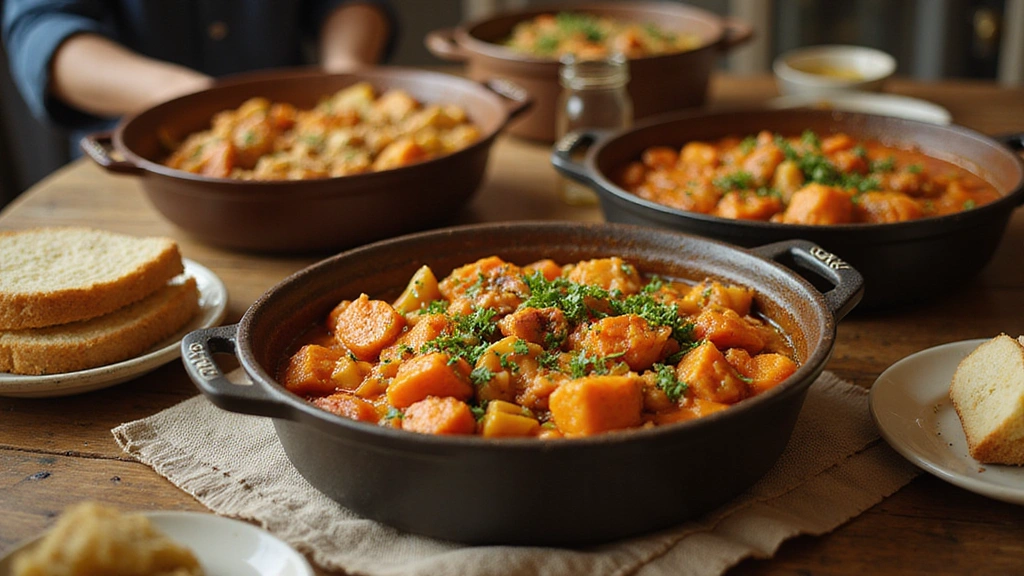
Soups and stews built from the recipes here gain flavor after a day in the refrigerator, and most keep for 4 to 5 days.
Lentil soup in particular thickens as it sits, so you will want to loosen it with a splash of water when you reheat.
Grains and roasted vegetables last about the same stretch. The cauliflower or sweet potato you roasted on Sunday still tastes like itself through Thursday if you stored it in a container with a tight lid.
The ones that fall apart on you are the stir-fries and any assembled taco. Crisp vegetables soften to rubber after even one night, and the quick-cooked sauce turns gummy in the microwave.
If you are going to pack a vegetable taco for lunch, store the filling and the tortilla separately, or just build it fresh.
Reheating is where I have ruined more lunches than I care to count.
The microwave on full power turns broccoli to army-green mush. What works better: a lower power setting with a damp paper towel over the bowl, which steams the vegetables back to tenderness without boiling them.
Or skip the microwave entirely and reheat grains and roasted vegetables in a hot skillet, which brings back some of the original texture.
A sheet pan at 375°F for 10 minutes does the same for a batch of roasted cauliflower or root vegetables, though I only bother when I have enough left to fill the pan.
Substitutions When You Are Missing Something

Most meatless dinners are forgiving. Cannellini beans mash into patties almost as readily as black beans, though they hold less moisture: if the mix feels dry, a tablespoon of water or reserved bean liquid brings it back.
Rice keeps the same 2-to-1 liquid ratio whether you reach for white, brown, or quinoa, but quinoa finishes in about 15 minutes, not 45, so add it later or accept a softer texture.
A can of coconut milk (13.5 oz) replaces a pint of heavy cream in curries and soups, though the sweetness shifts the profile.
Cashew cream blurs this further: soaked raw cashews blended with water at a 1-to-1 ratio by volume lands close to coconut milk’s richness without the sugar.
For an Impossible chili or any bean stew, this swap is invisible; the spices do the work.
Gluten-free without a special trip usually means corn tortillas in place of burger buns, or serving that veggie patty over rice instead.
Vegan is simpler than it sounds: skip the sharp white cheddar on those cannellini burgers and double the caramelized onion to keep the savory weight. The onion does more than the cheese did.
Frequently Asked Questions
What are some easy meatless recipes?
Pasta primavera, vegetable stir-fry, and chickpea curry all come together in under 30 minutes.
The stir-fry moves in 6 to 8 minutes, faster than the rice cooks beside it, and chickpea curry needs only a can of chickpeas, a can of coconut milk, and whatever spices are in your drawer.
How can I make meatless meals more satisfying?
Build your plate around protein-rich ingredients like beans, lentils, and whole grains, then layer in umami and fat.
Mushrooms, soy sauce, and tomato paste give savory depth, while nuts, cheese, or a drizzle of olive oil at the end bridge the gap between light and actually filling.
What are the health benefits of a meatless diet?
Eating less meat and more plants can promote a healthy weight and reduce your risk of diabetes, heart disease, and cancer. Even going meatless one or two days a week makes a measurable difference in long-term health outcomes.
What are meals that don’t include meat?
These 11 meatless main courses cover weeknight dinners without meat: vegetarian lasagna, stuffed peppers, vegetable stir-fry, chickpea curry, pasta primavera, vegetable tacos, lentil soup, quinoa salad, veggie burgers, ratatouille, and mushroom stroganoff.
What are some healthy recipes I can try?
Quinoa salad with cucumber, tomatoes, and a lemon vinaigrette keeps for four or five days in the refrigerator. Lentil soup thickens naturally from the starch in the lentils and sits heavy and steady as a comfort-food main course.
What are 10 good dinner foods?
For meatless dinners that eat like proper main courses, try vegetarian lasagna, stuffed peppers, vegetable stir-fry, chickpea curry, pasta primavera, vegetable tacos, lentil soup, quinoa salad, veggie burgers, ratatouille, and mushroom stroganoff.
What are some vegetarian meals that fill me up?
Lentil soup delivers protein and fiber that thickens into a clingy, full-bodied pot without any added starch.
Veggie burgers made from beans or grains need a hot pan and 4 to 5 minutes per side to build a crackling exterior and a center that reads warm all through.