
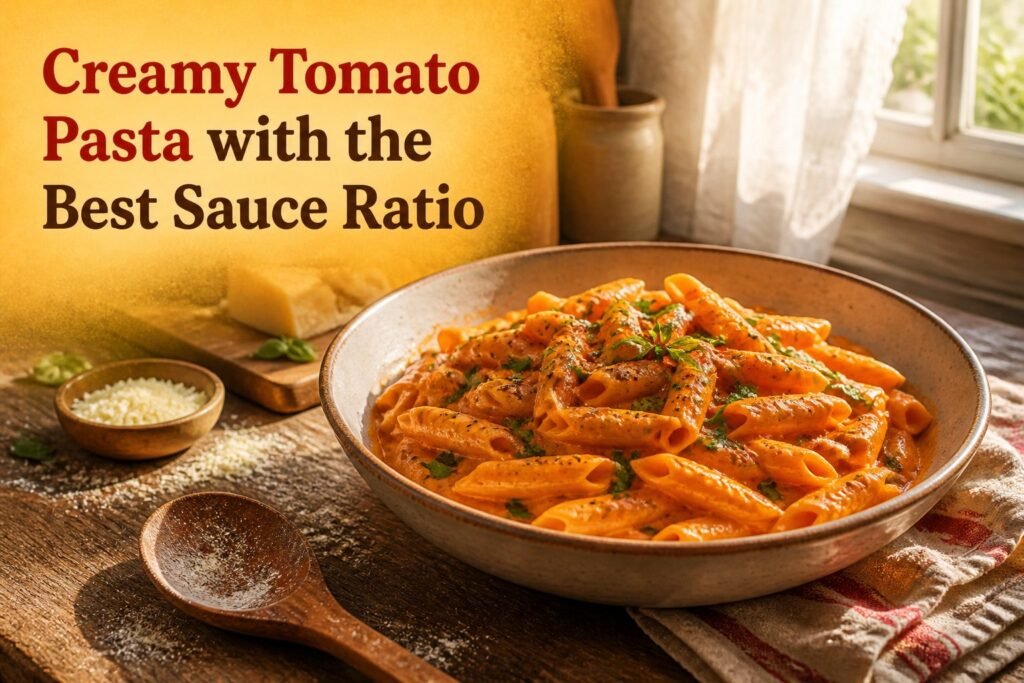
This version tastes like a balanced red-sauce bowl where the tomato stays bright and the cream rounds it without taking over.
The difference is the ratio: one third to one half cup of heavy cream against a full 28-ounce can of crushed tomatoes.
Any more and the tomato disappears; any less and you are eating tomato pasta with a suggestion of cream, not creamy tomato pasta.
Twenty to thirty minutes from pot to plate, with the sauce simmering while the pasta boils so nothing waits on anything else.
What to Buy

Here’s what goes into one batch of creamy tomato pasta, enough for 2 to 3 people depending on appetite and whether you add bread on the side.
- 8 oz dried pasta — short shapes like penne or rigatoni catch the sauce best, but spaghetti works if that’s what’s in the pantry
- 1 tablespoon olive oil for sautéing
- 1 small yellow onion, diced fine (about 1 cup); white onion substitutes fine
- 3 garlic cloves, minced; jarred is acceptable, use 1 heaping teaspoon
- One 28-oz can crushed tomatoes or one 24-oz jar marinara; the marinara route skips seasoning decisions but check the label for added sugar you may not want
- 1/3 to 1/2 cup heavy cream; start with the smaller amount if you prefer tang over richness
- 1/2 cup grated Parmesan, plus more for serving; the dusty shelf-stable kind melts differently than wedge-grated, and I reach for the wedge
- Small handful fresh basil leaves, torn; add at the very end or the heat muddies the flavor
The cream amount is the variable worth testing across makes. More than half a cup and the tomato starts to disappear; less than a third and you have tomato pasta with a suggestion of cream, not creamy tomato pasta.
Recommended Products

One 28 ounce can of Crushed Tomatoes in Purée

28 ounce can of organic crushed tomatoes with basil

Packed with Flavor: Our Crushed Tomatoes, made from vine-ripened tomatoes, never from concentrate, have a chunky, smooth consistency, the texture falling between diced tomatoes and a smooth tomato puree
How to Make It

- Bring a large pot of salted water to a rolling boil, then add 8 oz of pasta. Cook until al dente, tasting a minute before the package says it is ready. Right before you drain, scoop out 1 cup of the starchy pasta water and set it aside; that liquid is what binds the sauce later.
- Set a wide skillet over medium heat and pour in enough olive oil to coat the bottom. Add half a chopped onion and cook until softened, about 3-4 minutes. Stir in minced garlic and let it go 1 minute; pull the pan off heat the instant the garlic turns fragrant so it does not brown and turn bitter.
- Pour in one 28-oz can of crushed tomatoes or 24 oz of a plain marinara. Add 1/3 cup heavy cream, stir once, then let the sauce bubble gently for 5 to 10 minutes. A longer simmer thickens it; a shorter one keeps it looser for coating.
- Transfer the drained pasta straight into the skillet. Toss, then splash in reserved pasta water a few tablespoons at a time until the sauce clings rather than pools. The full cup rarely gets used, but having it matters.
- Take the pan off heat and finish with grated Parmesan and torn fresh basil. The total time lands between 20 and 30 minutes, depending on how long the tomatoes simmer.
Recommended Products
304 STAINLESS STEEL: Amrules 12oz creamer pitcher are crafted of 18/8 food grade stainless steel. The pitcher features external mirror finish and internal hairline finish. It is sturdy, durability, rust-resistant and resistant to deformation
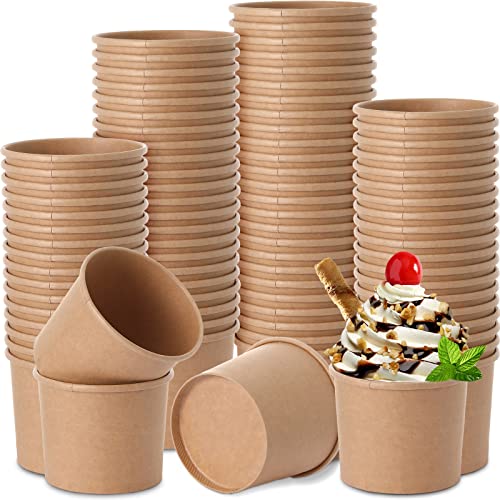
Sufficient quantity: you will get 100 pieces of brown cups for ice cream, which can meet your multiple uses, especially for ice cream shops, concession stands, restaurants, food trucks and bakeries

Easy-Clean Detachable Design: RAYMYLO reusable coffee mug features a detachable lid that takes off easily. Its user-friendly design means disassembly and reassembly are a breeze, allows you scrub away coffee stains from every nook and cranny. The included cup brush reaches deep into the stainless-steel interior, leaving no stubborn residue behind. Keep your coffee mug spotless with ease!
The Pasta Shape That Works

Penne was the first shape I reached for with this sauce, and for clear reasons.
The ridges on each tube grab hold of the cream and tomato so you get some coating in every bite, not a pool left behind on the plate.
The hollow center helps too; it traps small amounts of sauce inside, which runs out when you bite down.
Farfalle works differently. Those bow ties have folds and pinched centers that catch thicker sauce like a pocket, so you end up with little bursts of flavor where the cream gathers most.
It looks good on the plate, which matters when I am trying to get my kids to try something new, but the folds can also cook unevenly if the water is not at a hard boil.
Tagliatelle drapes instead of trapping. The wide, flat ribbons let the sauce sit on the surface in broad sheets, so you taste the balance between cream and tomato in each long strand.
It feels more like a restaurant dish, and I use it when I have an extra minute to plate with care.
Spaghetti winds the thinnest coat around each strand.
The sauce slides on smoothly but does not stay put the same way; you get more of a gloss than a layer, which can leave the eating feeling thin compared to the others.
These days I buy penne for weeknights and tagliatelle when someone I want to impress is at the table.
The other two sit in my pantry for variety, but penne handles the practical demands of this sauce better than anything else I have tried.
Recommended Products

Brought to you by Whole Foods Market
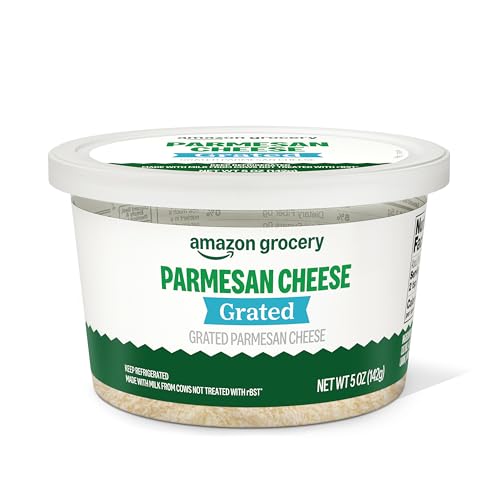
One 5 ounce container of Grated Parmesan Cheese

Bottle Fees May Be Applied to Price
Creamy Options Beyond Heavy Cream

A blended 200 grams of cottage cheese disappears into tomato sauce with almost no trace, leaving behind a mild, dairy-rich body and enough protein to make the bowl feel substantial.
The sauce turns thick and almost fluffy, closer to a pink vodka sauce than an Alfredo.
Goat cheese, about 4 ounces, melts in differently; its tang sharpens the tomato’s acidity rather than softening it, and the sauce clings to pasta with more density than drape. Some nights that edge is exactly what I want.
Heavy cream sits in the middle by design: neutral, predictable, reliable in a way that lets the tomato stay in charge. It thins more than it thickens at typical pours, so the sauce stays pourable rather than spoonable.
Coconut milk is the outlier that works anyway. A can stirred into jarred marinara builds a dairy-free sauce with real heft, though the coconut flavor cooks out almost completely if the sauce simmers long enough.
The finish is silkier than cottage cheese, less assertive than goat, and the only option here that covers both vegan and higher-fat diets without splitting.
Recommended Products

MEZZI RIGATONI PASTA: This pantry staple blends pasta rigatoni heartiness with a smaller size; large diameter plus ridges retain sauce across the surface, inside and out
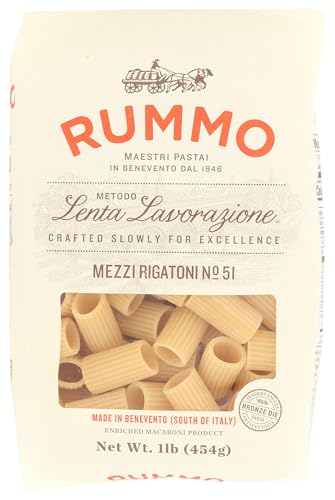
150+ banned colors, flavors, preservatives and other ingredients often found in food
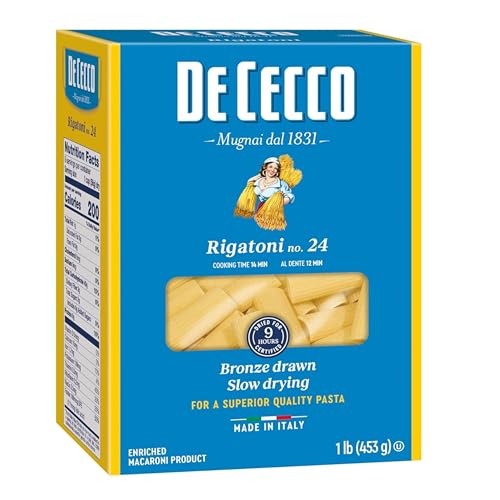
Authentic Italian Pasta: De Cecco Rigatoni No. 24 is a traditional Italian pasta with wide, ridged tubes and a sturdy shape designed to capture and hold thick, rich sauces in every bite
Building the Flavor

Onion goes in first, always. Three to four minutes over medium heat softens it without taking on color, and that window matters because browned onion tips the whole sauce toward sweetness when you want a clean, savory base.
Garlic follows for one minute, no more; the line between fragrant and bitter is narrow, and bitter garlic will not hide behind tomatoes and cream.
Basil and chili flakes land after the tomatoes are already simmering. The heat wakes the chiles up slowly, so the warmth builds rather than bites, and the basil has time to melt into the sauce instead of frying on contact.
If the tomatoes come in too sweet, a pinch more chili or a splash of vinegar pulls them back.
Too sharp, and a small spoonful of sugar rounds the edge without making it taste like dessert. I adjust by quarter-teaspoons, tasting between each, because a tomato that needed help in January may be perfect in August.
Recommended Products

25 oz organic fat-free marinara pasta sauce
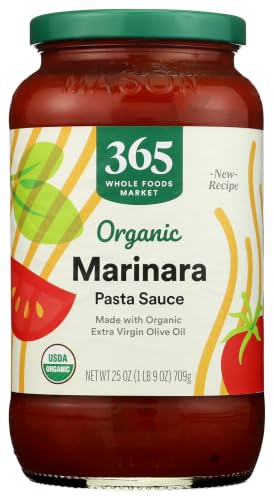
Organic marinara pasta sauce with no added sugar

BARILLA PASTA SAUCE: We're passionate about bringing the best possible sauce to your home; delivering the quality, flavor and texture you expect - every time and in every dish
Tomato Base: Fresh, Jarred, or Sun-Dried

The tomato base sets the whole tone of the dish, and I have landed on three that work reliably with cream.
A 24–28 oz jar of marinara or crushed tomatoes gives the loosest, most spoonable sauce, with the kind of bright acidity that cuts through dairy without going sharp.
The finished result tastes like what you would get at a casual red-sauce place, which is not an insult in my kitchen on a Tuesday.
An 8.5 oz jar of sun-dried tomatoes plus 1 cup heavy cream and 1½ cups milk builds something else entirely.
The sun-dried tomatoes rehydrate into a concentrated, almost jammy base that clings to pasta instead of pooling under it. The flavor leans sweet and deep, more roasted-red-pepper than fresh tomato, and the cream has to work harder to balance it.
I use this when I want the sauce to be the main event, or when I am feeding people who think they do not like tomato sauce.
Jarred marinara wins for speed and cleanup. Sun-dried wins when I have an extra two minutes to buzz the tomatoes soft in the blender and I want leftovers that taste better the next day.
Crushed tomatoes split the difference: thicker than marinara, less intense than sun-dried, and cheap enough that I do not mind adjusting by taste as it simmers.
Recommended Products

28-ounce can of organic fire-roasted crushed tomatoes
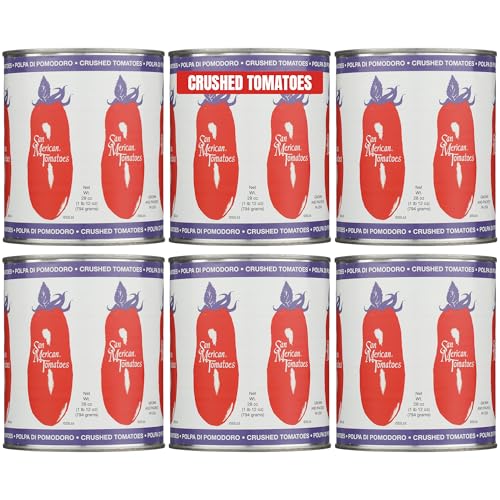
Grown And Packed In The USA: San Merican whole tomatoes are crushed and sealed at peak ripeness, so every can delivers a dense, full-bodied base instead of a thin, watery one; No fillers and no added sugars - the nutrition panel confirms 0g added sugars; Just an honest crushed tomato base, the way your sauce deserves to start

The information below is per-pack only
Timing for a Weeknight

5 minutes of actual prep plus 15 to 30 minutes of cooking lands this on the table in 20 to 30 minutes total. The timer starts when the pot goes on the stove to boil because that 10 to 12 minute pasta window is free time.
I dice the onion, mince the garlic, and open the tomatoes while the water still rolls in, then the sauce simmers in that same saucepan while the pasta finishes.
Both hit done within a minute of each other if I set the pasta going right at the start.
The overlap is what makes it a Tuesday meal, not a weekend project.
No step waits on another. If the sauce thickens faster than the penne cooks, it holds on low heat; if the pasta beats the sauce, the colander is fine for a minute or two.
Either way, I am plating before anyone asks what is for dinner.
Recommended Products

Enough Quantity: The package comes with 210 pack ice cream cups in 6 colors, each measures 2.7 inches in height with diameter of 3.8 inches, capacity: 12 oz. To meet your needs at parties and special events

Package Includes: Pack of Two fine bone china coffee mugs, each with a 12 Ounce capacity. Designed in Europe and made in India, these beautifully crafted mugs combine elegant style with everyday practicality for your kitchen or dining set and mothers day gifts for mom

Easy-Clean Detachable Design: RAYMYLO reusable coffee mug features a detachable lid that takes off easily. Its user-friendly design means disassembly and reassembly are a breeze, allows you scrub away coffee stains from every nook and cranny. The included cup brush reaches deep into the stainless-steel interior, leaving no stubborn residue behind. Keep your coffee mug spotless with ease!
What One Serving Carries

The cottage cheese delivers about as much protein as a pair of eggs per 200-gram serving, which is the quiet reason this sauce keeps you full without weighing the dish down.
I do not count calories myself, but I understand why readers do, and the swap from heavy cream to cottage cheese changes the math substantially.
Cream carries roughly 800 calories in a cup against cottage cheese’s 200 or so, and the difference shows up on the palate as brightness rather than heft.
Swaps shift the character more than they shift the numbers. Half-and-half lands in between, still creamy but less tangy, while cream cheese thickens aggressively and wants more liquid to loosen it.
Marinara from the jar already carries salt and sugar, so the cottage cheese’s mildness works with it rather than against it.
The shredded cheese and parmesan on top are where the indulgence lives; pull back there if you want a lighter plate, not in the sauce base where the protein does its work.
Recommended Products

One 5 ounce container of Shredded Parmesan Cheese

All natural cheese full, nutty flavor.

BelGioioso Cheese Cup Shaved Parmesan, 5oz.
Leftovers and Reheating

The sauce tightens in the refrigerator as the fat and starch molecules realign and grab onto each other. What was silky on the plate becomes a dense, almost pudding-like mass after a night in the cold.
A splash of milk or reserved pasta water, added while the pasta warms in a skillet over low heat, restores the loose creaminess without letting the dairy separate or the tomatoes turn grainy.
I keep my pasta water in a jar on the counter for exactly this reason; microwave reheating dries the sauce out further and leaves the edges rubbery.
Three to four days is the safe window in the fridge, after which the dairy base turns sour faster than a straight tomato sauce would.
If the leftover portion looks too thick even before reheating, start with milk, since pasta water thins but does not enrich the way a tablespoon of dairy does.
Recommended Products

VERSATILE PAIRING - The ample, ridged tubes of Rigatoni, allows the sauce to cling to the ridges and enhance the overall flavor, making it versatile in various dishes

MADE IN ITALY: DeLallo Semolina Pasta begins with a high-quality durum wheat. The wheat is chosen for its beautiful color, wonderful aroma and high protein content
![Simple Pasta: Pasta Made Easy. Life Made Better. [A Cookbook]](https://m.media-amazon.com/images/I/51gTfCm8mtL._SL500_.jpg)
Frequently Asked Questions
Recommended Products

Bring home the famous taste of Rao's with this 15.5 ounce jar of Rao's Homemade Marinara Sauce
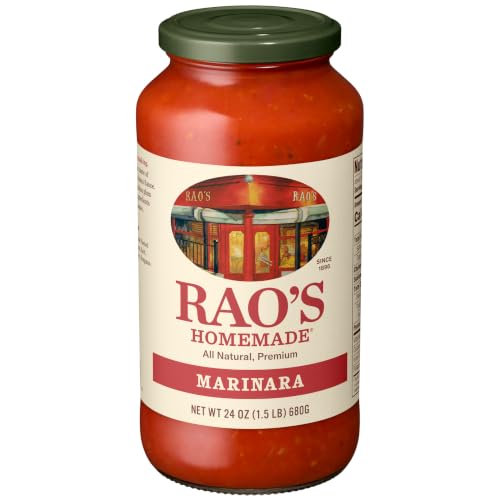
Bring home the famous taste of Rao's with this 24 ounce jar of Rao's Homemade Marinara Sauce

MARINARA PASTA SAUCE - Rooted in Italy's rich culinary traditions, this pasta sauce brings genuine flavor and quality to your table. Use it for spaghetti, pizza, lasagna, and more
What is creamy tomato pasta?
Creamy tomato pasta is a dish made by combining pasta with a creamy tomato-based sauce.
The version in this recipe blends crushed tomatoes or marinara with heavy cream, Parmesan, and fresh basil for a sauce that stays pourable rather than spoonable. It lands on the table in 20 to 30 minutes, making it a practical weeknight meal.
How do you make creamy tomato sauce?
You make creamy tomato sauce by softening diced onion in olive oil, adding minced garlic for one minute, then pouring in crushed tomatoes or marinara and letting it bubble with heavy cream for 5 to 10 minutes.
The cream amount is the variable worth testing: start with 1/3 cup for tang, go up to 1/2 cup for richness, but more than that and the tomato starts to disappear.
Finish the sauce off heat with grated Parmesan and torn fresh basil so the heat does not muddy the herb’s flavor.
What pasta goes well with creamy tomato sauce?
Penne, farfalle, tagliatelle, and spaghetti all work, but penne handles the practical demands best. The ridges grab cream and tomato so you get coating in every bite, and the hollow center traps small amounts of sauce inside.
Tagliatelle feels more like a restaurant dish for guests; farfalle’s folds catch thicker sauce in pockets but can cook unevenly; spaghetti gives the thinnest coat and can leave the eating feeling thin compared to the others.
How to make tomato pasta more creamy?
Add up to 1/2 cup heavy cream to a 28-ounce can of crushed tomatoes or 24 ounces of marinara, but stop there or the tomato flavor disappears.
For a thicker, almost fluffy texture without more cream, blend 200 grams of cottage cheese into the sauce; it adds protein and a dairy-rich body with fewer calories.
A splash of reserved pasta water while tossing also helps the sauce cling rather than pool, which reads as creamier on the plate.