
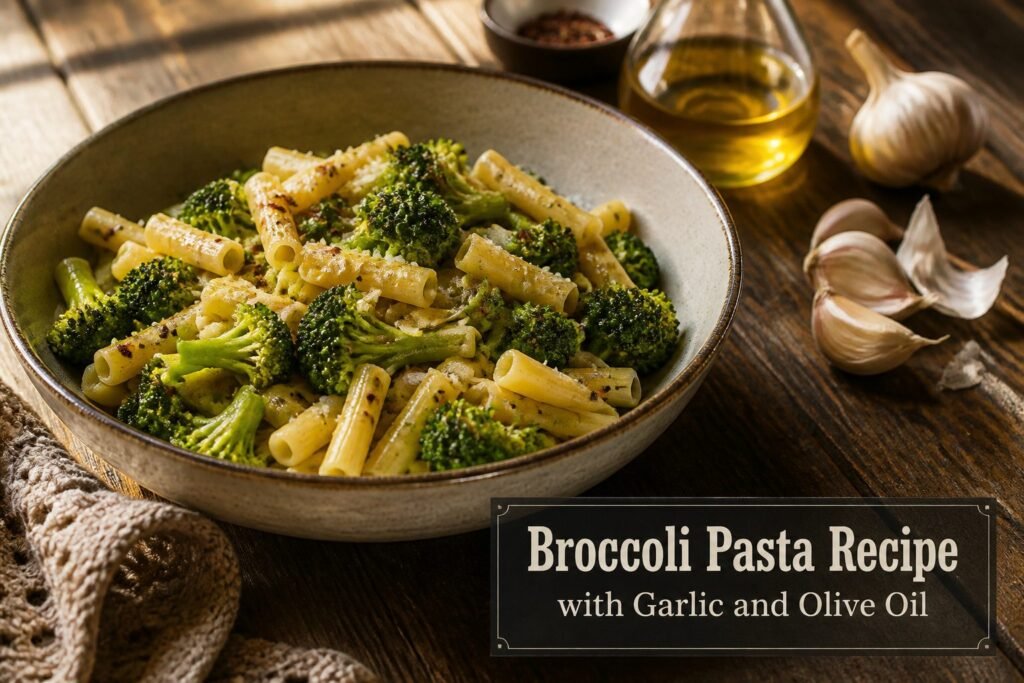
This broccoli pasta recipe tastes light and savory, with olive oil and garlic coating tender florets and short pasta in about 30 minutes.
What sets it apart is the shared pot: broccoli and pasta boil together, so the only chopping is florets and a few garlic cloves. Timing is the only part that asks for attention.
Broccoli goes from bright to army-colored fast, and if you like any bite left, you need to watch the clock or accept softer florets for the sake of one fewer dish to wash.
I reserve 3/4 cup of that starchy water before draining; it emulsifies into sauce without turning the dish loose and watery.
What This Is and When I Make It

The broccoli in the crisper goes from upright to slouched in about three days, and that posture change is usually my trigger.
Tuesday night, 6:47 PM, no plan and no patience for the question of what to cook. This is when I reach for this dish.
30 minutes from walking in the door to plate, and that includes the time it takes to fill the pot.
The recipe works because the broccoli and pasta cook in the same water, so the only real chopping is the broccoli into florets and a couple of garlic cloves.
The specific kind of tired this answers is decision fatigue, not just physical exhaustion. Sequence and timing take care of themselves; the water boils, things go in, olive oil and garlic warm in a pan while the pasta finishes.
Some nights I use one pot and skip the separate pan entirely, tossing everything together with pasta water and cheese right in the colander.
Other nights the separate pan happens because I started the garlic too early and needed somewhere for it to go.
Both ways work. The result is somewhere between a side and a main, saucy without being heavy, and the leftover half of that broccoli head does not become science experiment material by Friday.
Recommended Products
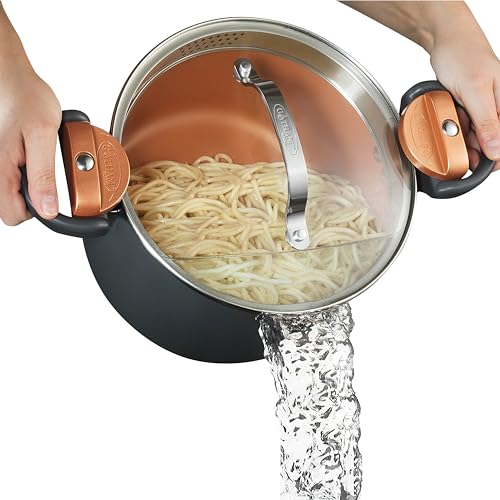
5 QUART PASTA POT WITH STRAINER LID — This nonstick ceramic stock pot cooks and drains spaghetti, penne, soup, rice, and vegetables in one pot, no colander needed. The built-in strainer lid, twist and lock handles, and dishwasher safe design make it the easiest way to cook pasta without the mess.

5 QUART PASTA POT WITH STRAINER LID — This nonstick ceramic stock pot cooks and drains spaghetti, penne, soup, rice, and vegetables in one pot, no colander needed. The built-in strainer lid, twist and lock handles, and dishwasher safe design make it the easiest way to cook pasta without the mess.

Ingredients

The ingredient list for this broccoli pasta recipe stays short because the technique does most of the work.
I cut the broccoli into small florets, about 4 cups from 1 to 1.5 pounds, so they cook through quickly and get a little tender without turning to mush.
- 12 oz short pasta: penne, fusilli, or orecchiette
- 1 to 1.5 lbs fresh broccoli
- 3 tbsp extra virgin olive oil
- 3 garlic cloves, thinly sliced
- 1/4 tsp red pepper flakes (optional)
- 1/2 cup grated Parmesan or Pecorino Romano
- 1 tbsp lemon juice (optional)
- 2 tbsp butter (optional)
- Fresh parsley or basil for garnish
Reserve 3/4 cup pasta water before draining. Some recipes call for a full cup, but I find that much makes the sauce too loose; 3/4 cup gives you the starch you need for emulsion without diluting the flavor.
The butter and lemon juice are optional additions I add when I want something richer or brighter, and the red pepper flakes I skip entirely on nights my kids are picking at everything.
Recommended Products

Knorr Pasta Sides Parmesan is a side dish that enhances meals with amazing flavor

Knorr Pasta Sides Butter Fettuccine is a pasta side dish that enhances meals with amazing flavor.

Method

- Cut the broccoli into small florets and peel the stems, then slice those stems into thin coins or small cubes so nothing goes to waste.
- Boil 4 quarts of salted water, add the broccoli, and set your timer: 3 minutes keeps it firm with bite, 8 minutes turns it fully soft. The color shifts from dull green to bright; taste a piece at the low end if you are unsure.
- Drop the pasta into that same boiling water and cook 8–12 minutes until al dente. The package time is a starting point; fish out a noodle at the low end and bite.
- Before you drain, scoop out 3/4 cup of the starchy pasta water and set it aside. Then drain the pasta and broccoli together.
- Warm olive oil in your widest skillet over medium-low heat, add sliced garlic, and sauté just until the edges turn golden, about 1 minute. Toss in red pepper flakes now if you want heat.
- Add the drained pasta and broccoli to the skillet, pour in the reserved pasta water a few tablespoons at a time, and toss until the sauce clings instead of pools.
- Finish with grated cheese, a squeeze of lemon if you like acidity, and fresh herbs. Serve immediately while the garlic still hums.
Recommended Products

Organic Italian herb pasta sauce made with premium tomatoes

CLASSIC MARINARA SAUCE: 24 oz jar of Bertolli Traditional Marinara Pasta Sauce with tomatoes, garlic, herbs, and olive oil

You can make delicious pasta dish with just mixing this Peperoncino sauce with cooked pasta
Cooking Times for Broccoli

Small florets submerged in boiling water go through a fast transformation that is easy to miss.
At 1 to 2 minutes, the bright green color locks in and the texture stays almost raw, which is useful if the pasta will sit for any length of time before serving.
By 4 to 5 minutes, the broccoli softens to the point of yielding under a fork but still retains some structure; this is the window most weeknight recipes call for.
Leave it 8 to 10 minutes and the florets collapse entirely, becoming something you can crush into a sauce with the back of a spoon.
What I actually do in my own pot falls between those markers. Three minutes of cooking gives me distinct pieces that stand on their own against the pasta, each floret recognizable and separate.
Seven minutes gets me almost to a creamy state without going all the way to the skillet-mashing step some recipes require, though those extra minutes mean I had better be ready to toss everything together immediately.
The stem pieces, cut into 1-inch chunks, need that extra attention. They carry more fiber and density than the florets, so I give them 1 to 2 minutes longer in the water.
Dropping them in first, then adding the florets after, prevents the dramatic half of my broccoli from turning to mush while I wait for the stems to catch up.
Recommended Products

【High Temperature Resistant】 This large veggie steamer is made for microwave cooking, and made of high-quality materials, is BPA-free and dishwasher safe, 100% food safety. Suitable for steaming all kinds of food.
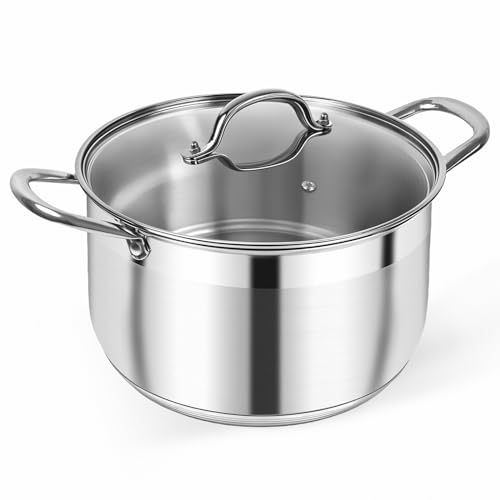
Stainless steel and 5 layers bottom: Kirecoo 8-Quart Stainless Steel Stockpot with Lid is an essential kitchen cookware, boasting an advanced stainless steel construction with a 5-layer thickened base. This cooking pot features high temperature and corrosion resistance, promising a long service life without easy deformation. Composed of aluminum, iron, aluminum, and a magnetic base, the 5-layer bottom of stockpot has good sturdiness and performance. It heats quickly and distributes heat evenly.
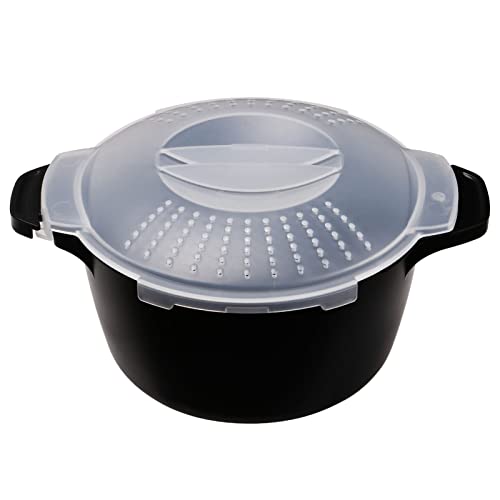
【High Temperature Resistant】 This mini steamer is made for microwave cooking, and made of high-quality materials, is BPA-free and dishwasher safe, 100% food safety. Suitable for steaming all kinds of food.
Pasta Types That Work

Short pasta shapes give this dish its best texture.
Penne holds sauce inside its tubes so you get a little with every bite. Fusilli traps bits of broccoli and garlic in its spirals, and orecchiette cups small florets like a scoop.
I reach for fusilli most often because the ridges and curls catch the softened broccoli better than smoother shapes, and the corkscrews stay intact when I stir them into the skillet.
Long pasta like spaghetti or linguine works, but twirling strands around a fork becomes awkward once you add large broccoli pieces; florets fall off the tines and the meal turns into chase work.
Eight to twelve ounces of dried pasta feeds four at a standard serving, and I usually cook the smaller amount when we’re eating this as a light dinner and the larger one when it’s the only thing on the table.
Recommended Products


Cheese and Flavor Differences

Parmesan and Pecorino Romano treat this broccoli pasta recipe differently. Parmesan brings a nuttier, milder profile and melts into a creamier, more integrated finish against the olive oil.
Pecorino is saltier, sharper, more aggressive on the tongue. Pre-grated cheese from the dairy aisle does not melt the same, so buy a wedge and grate it yourself.
A quarter cup gives a light background note; up to a full cup turns the dish into something almost cacio e pepe-adjacent, with the broccoli there for balance.
I reach for Parmesan when my kids are at the table, since its mellowness slides past them without complaint.
When I am eating alone, Pecorino wins. The salt punch means I barely miss the additional salt I would have added for Parmesan.
Recommended Products
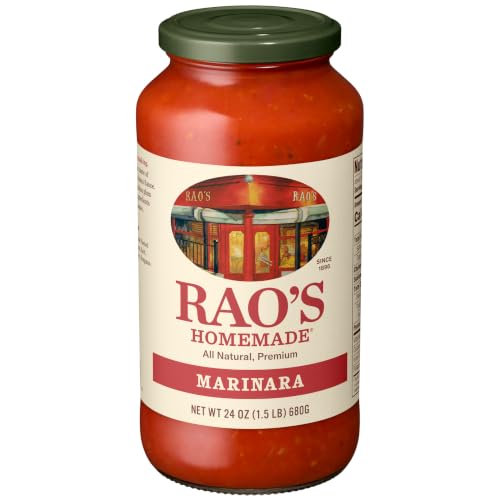
Bring home the famous taste of Rao's with this 24 ounce jar of Rao's Homemade Marinara Sauce

CLASSICO PASTA SAUCE: One 24 oz jar of Classico Roasted Garlic Pasta Sauce

100% Natural, cold-pressed extra virgin olive oil infused with garlic extract
Sauce Variations

A few additions turn the basic garlic and olive oil sauce into something brighter or spicier or more forgiving, and each of these stays optional.
Lemon juice and zest do the most work for me.
Use 2 tablespoons juice and 1 to 2 teaspoons zest; both are worth including more often than not. The acid cuts the one-note richness of olive oil and gives the broccoli something to cling to that reads as deliberate rather than accidental.
A Microplane makes the zest part quick, but the fine side of a box grater works if that is what you have.
Red pepper flakes run 1/4 teaspoon in most versions, though half the sources nudge upward.
I add this when someone at the table wants heat, skip it when the kids are particularly tired of everything. It is not subtle; the flakes bloom in the warm oil and announce themselves.
Butter for richness, usually 2 tablespoons, is the one I leave out when I am already depleted.
It wants its own small pan to brown gently, or at least a careful eye so it does not scorch, and on a Wednesday that asks too much.
The olive oil alone carries the dish. Add the butter when you want to serve this to someone you are trying to impress, or when the broccoli itself was not the freshest bunch at the store and needs the help.
Recommended Products

Durable Construction: Our vegetable asparagus cooker is constructed of heavy duty stainless steel to make it everlasting. The extra thick 3-ply capsuled bottom done by impact bonding transfers heat quickly and efficiently, thus resulting in even cooking while preventing hot spots. High polished stainless steel cooking surface offers superior stick resistance and will not react with food. Safe to use.


【18/8 Food Grade Stainless Steel】 Durable, resistant to rust, stain, corrosion or crack. Easy cleanup and will not affect or react with foods
Frozen Broccoli

Frozen broccoli works fine in this recipe, and I keep a bag in the freezer for nights when the produce drawer is empty.
Drop it straight into the boiling pasta water for the last 4–5 minutes rather than thawing or steaming it separately.
The florets come out softer than fresh broccoli would at the same stage, closer to the texture you’d get from an 8–10 minute cook on the fresh stuff.
Some cooks prefer to defrost and drain frozen broccoli first to keep the final dish from getting watery; I’ve had better luck skipping that step and just letting the pasta water do the work, though a splash of the reserved cooking liquid helps bind everything if the pan looks dry.
Fresh broccoli still wins on snap and sweetness when I have it, but frozen is more economical through winter and saves a cutting board.
Recommended Products

Knorr Pasta Sides Creamy Chicken is a side dish that enhances meals with amazing flavor.

Yield and Leftovers

Twelve ounces of dried pasta and one and a quarter pounds of broccoli make 4 solid servings, not the skimpy kind that leaves you hunting for snacks an hour later.
The broccoli cooks down more than you’d expect, so the ratio ends up generous without being a pasta salad in reverse.
Leftovers keep for 3 days refrigerated in a container with a tight lid. The sauce tightens up as it sits, so you’ll want to loosen it with a splash of water before reheating.
A microwave works in a pinch, but a skillet on the stovetop with a couple tablespoons of water gives you back the saucy texture that makes the dish worth eating twice.
Skip the freezer entirely. The broccoli turns mushy and the pasta seizes up, and neither one comes back from it.
Recommended Products

RICH & BOLD FLAVOR: Reach for the flavor of bold garlic and rich olive oil to infuse everyday and special occasion meals with unforgettable flavor the whole family will love.


Garlic Minced
One-Pot Versus Separate Cooking

Broccoli and pasta can share one pot of boiling water, and the broccoli throws off starch that thickens the pasta water into something sauce-like.
The downside is timing. The pasta needs its full cook time, but broccoli added in the last 4 to 5 minutes can still soften past what you’d want, especially if you like any bite left in the florets.
That same water can turn bright green broccoli army-colored if it sits too long.
Cooking them separately fixes both problems. A second pot of salted water lets you pull the broccoli the second it hits tender, and the color stays vivid on the plate.
Saturday dinner, when I have the sink space and the patience, this is the route I take. Tuesday night, the one-pot version wins because one fewer dish to wash is a real number in my evening.
The texture sacrifice is noticeable but not fatal, and a quick toss with the garlic olive oil covers a lot of sins.
Recommended Products

MULTIPURPOSE POT - Life in the kitchen is easier when you use the right tool for the task, the asparagus pot is designed for everything from simmering sauces to cooking...
Frequently Asked Questions
Can I use frozen broccoli?
Yes.
Drop it straight into the boiling pasta water for the last 4 to 5 minutes without thawing first. The florets cook up softer than fresh broccoli would at that stage, closer to an 8 to 10 minute cook on the fresh stuff.
Fresh still wins on snap and sweetness if you have it, but frozen saves a cutting board and works well through winter.
What type of pasta works best?
Short pasta shapes work best. Penne holds sauce inside its tubes, fusilli traps broccoli and garlic in its spirals, and orecchiette cups small florets like a scoop.
Fusilli is my usual pick because the ridges catch softened broccoli better than smoother shapes. Long pasta like spaghetti works but gets awkward to twirl once you add large broccoli pieces.
How do I prevent the broccoli from becoming mushy?
Cook it for 3 minutes if you want firm florets with bite, or up to 5 minutes for something that yields under a fork but still keeps structure.
The color shifts from dull to bright green; taste a piece at the low end if you are unsure.
If you are cooking broccoli and pasta in the same pot, add the broccoli in the last few minutes so it does not sit in hot water while the pasta finishes.
What to put in broccoli pasta?
You need broccoli, short pasta, olive oil, garlic, and grated cheese.
Parmesan or Pecorino Romano melted with reserved pasta water makes a creamy sauce without cream. Red pepper flakes, lemon juice, and butter are common additions depending on whether you want heat, brightness, or richness.
What sauce goes well with broccoli pasta?
A simple garlic and olive oil sauce is the base, emulsified with starchy pasta water and grated cheese into something that clings instead of pools.
Lemon juice and zest add brightness, butter adds richness, and red pepper flakes add heat. No cream or heavy sauce needed; the broccoli itself softens into the dish and helps the texture.
Should you cook broccoli before adding to pasta?
You can cook them together in the same pot, which saves a dish and lets the broccoli starch thicken the pasta water.
Add the broccoli in the last 3 to 8 minutes depending on how soft you want it. Cooking them separately in two pots lets you pull the broccoli at exactly the right texture and keeps the color vivid, but takes more cleanup.
How do you add flavor to broccoli pasta?
Sauté thinly sliced garlic in olive oil until the edges turn golden, about a minute, then toss in red pepper flakes if you want heat.
Finish with grated cheese, lemon juice for acidity, and fresh parsley or basil. Pecorino Romano gives a saltier, sharper punch than Parmesan; butter adds richness if you want to push it further.